
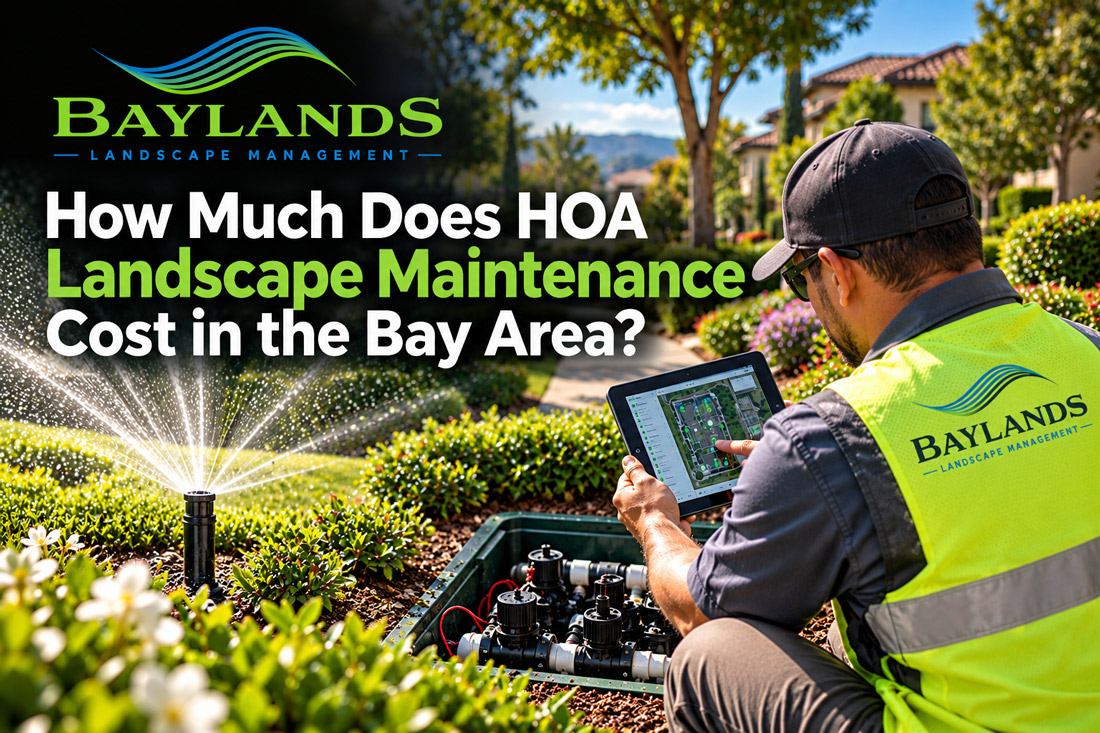
Smart Irrigation for HOAs: Saving Water, Protecting Landscapes, and Planning for the Future
For many homeowners associations in the Bay Area, water has become one of the largest and most difficult landscape expenses to control.
When an HOA receives a high water bill, the first reaction is often to reduce irrigation run times. But simply watering less isn’t always the answer. In fact, reducing watering without understanding the irrigation system can lead to stressed lawns, declining plants, dry areas, and ultimately additional landscape replacement costs.
A better approach is to understand where the water is going and how efficiently it is being used.
At Baylands Landscape Management, we believe irrigation should be managed as an important part of the overall health and financial stewardship of an HOA landscape.
Smart Irrigation Is More Than a Smart Controller
Smart irrigation controllers have become an important tool for landscape water management. Depending on the system, today’s technology can use weather information, seasonal adjustments, remote access, flow monitoring, and other data to help manage irrigation more efficiently.
But there is something important HOA boards and property managers should understand:
Installing a smart controller does not automatically make an irrigation system efficient.
The controller is only one part of a much larger system.
An HOA may still have leaking valves, broken lateral lines, poor sprinkler coverage, incorrect nozzles, pressure problems, clogged drip emitters, outdated irrigation components, or landscape areas that have changed significantly since the irrigation system was originally designed.
Technology is valuable, but it works best when the irrigation infrastructure itself is properly maintained.
From Reactive Irrigation to Proactive Water Management
Traditionally, many irrigation problems are discovered after something has already gone wrong.
A resident reports water running down the street. A maintenance crew notices a broken sprinkler. Plants begin declining. Or the HOA receives an unusually large water bill.
Modern irrigation technology can help change that approach.
Flow monitoring, for example, can help identify unusual water usage that may indicate a broken pipe, stuck valve, or other irrigation problem. Remote access can also allow irrigation professionals to review programming and make certain adjustments without waiting until the next scheduled landscape visit.
The goal is to identify problems earlier—before unnecessary water use becomes an expensive surprise.
Watering Less Isn’t Always Water Conservation
True water conservation isn’t simply reducing every irrigation station by the same percentage.
Different landscape areas have different needs.
A sunny lawn has different water requirements than a shaded planting bed. Established shrubs may need different irrigation than newly installed plants. Drip irrigation operates differently from overhead spray irrigation. Soil conditions, slope, exposure, plant material, and seasonal weather all influence how much water a landscape requires.
That’s why irrigation schedules should be reviewed and adjusted throughout the year.
The objective should be simple:
Deliver the right amount of water, to the right landscape, at the right time.
Aging HOA Irrigation Systems Need a Plan
Many Bay Area HOA communities were built decades ago, and portions of their irrigation infrastructure may be just as old.
Over the years, repairs are made as problems occur. A valve gets replaced here. A broken pipe is repaired there. Sprinklers are changed. Drip systems are added. Landscaping changes.
Eventually, an HOA can end up with an irrigation system made up of several generations of components.
Rather than continuing to address every problem individually, it can be helpful to step back and evaluate the irrigation system as a whole.
That doesn’t necessarily mean replacing everything.
In many cases, the better solution is developing a phased irrigation improvement plan.
Phase 1: Address Immediate Problems
Repair active leaks, broken irrigation components, malfunctioning valves, serious coverage problems, and other conditions that are currently wasting water or affecting landscape health.
Phase 2: Improve Irrigation Management
Review controller programming, seasonal watering schedules, pressure, sprinkler coverage, drip irrigation, and opportunities for smart-control technology or flow monitoring.
Phase 3: Plan Long-Term Improvements
Identify aging infrastructure and inefficient areas that can be improved gradually over several budget cycles.
This approach allows an HOA to prioritize its money instead of facing one large irrigation project all at once.
Water Bills Can Tell a Story
When available, historical water bills can be extremely useful.
Looking at several months—or even several years—of water consumption can help establish a baseline and identify unusual changes.
Water-use information becomes even more valuable when combined with knowledge of the property’s irrigation system, landscape square footage, seasonal conditions, and recent repairs.
Instead of simply asking, “Why is our water bill so high?”, an HOA can begin asking better questions:
Where is our irrigation water being used?
Are there areas using more water than necessary?
Do we have leaks or aging infrastructure?
Are our irrigation schedules changing with the seasons?
Would flow monitoring help us identify problems sooner?
Are there areas that could eventually be converted to more water-efficient landscaping?
Those questions can lead to better long-term decisions.
California HOAs Should Also Be Thinking About AB 1572
Another important consideration for California HOAs is Assembly Bill 1572 (AB 1572) and the state’s restrictions on using potable water to irrigate certain nonfunctional turf.
For homeowners associations, the requirements involving common areas are scheduled to take effect beginning January 1, 2029.
This makes the next few years an important planning period.
Rather than waiting until the deadline approaches, HOA boards can begin identifying areas of ornamental turf that may be affected and evaluating alternatives.
Not every lawn is necessarily nonfunctional turf, and each property should be evaluated based on how its landscape areas are actually used and the applicable regulations.
However, early planning gives communities more time to consider plant selection, irrigation modifications, project costs, available rebates, and how landscape changes will affect the appearance of the community.
Every HOA Is Different
There is no single irrigation solution that is appropriate for every community.
A small HOA with one controller and a handful of irrigation stations has very different needs from a large community with multiple controllers, hundreds of irrigation components, extensive landscaping, and a substantial annual water budget.
That’s why irrigation improvements should begin with understanding the property.
Before recommending major upgrades, we believe it is important to determine:
- What irrigation infrastructure is currently in place?
- What condition is it in?
- Where are the biggest sources of water loss or inefficiency?
- What needs immediate attention?
- What improvements can wait?
- What can realistically fit within the HOA’s budget?
The answers help create a practical roadmap rather than simply a list of repairs.
Landscape Maintenance Is Becoming Landscape Stewardship
The role of a professional landscape company is changing.
Maintaining an HOA landscape isn’t only about mowing lawns, pruning shrubs, blowing walkways, and repairing sprinklers.
It increasingly involves understanding water consumption, irrigation technology, plant health, sustainability, long-term budgeting, and changing California water requirements.
For HOA boards and community managers, having a landscape partner who understands these issues can help protect both the appearance of the property and the association’s investment.
At Baylands Landscape Management, our goal is not simply to reduce watering.
Our goal is to understand where a property’s water is going, identify unnecessary water loss, protect the health of the landscape, and help communities develop practical improvements that can be implemented over time.
Good irrigation management shouldn’t begin when a pipe breaks or a large water bill arrives.
It should be an ongoing part of taking care of the property.

Ruben and his team at Baylands Landscape Management did a great job on the project. They were able to come out during a short window time frame to assess the project and schedule the earliest time to tackle it. The team was able to finish the project the same day with great detail and touch. Will recommend Ruben and the team for other gardening jobs.
The word I have to describe Baylands landscaping in “polite”. The job was done timely and completely Very responsive. Will definitely hire again


